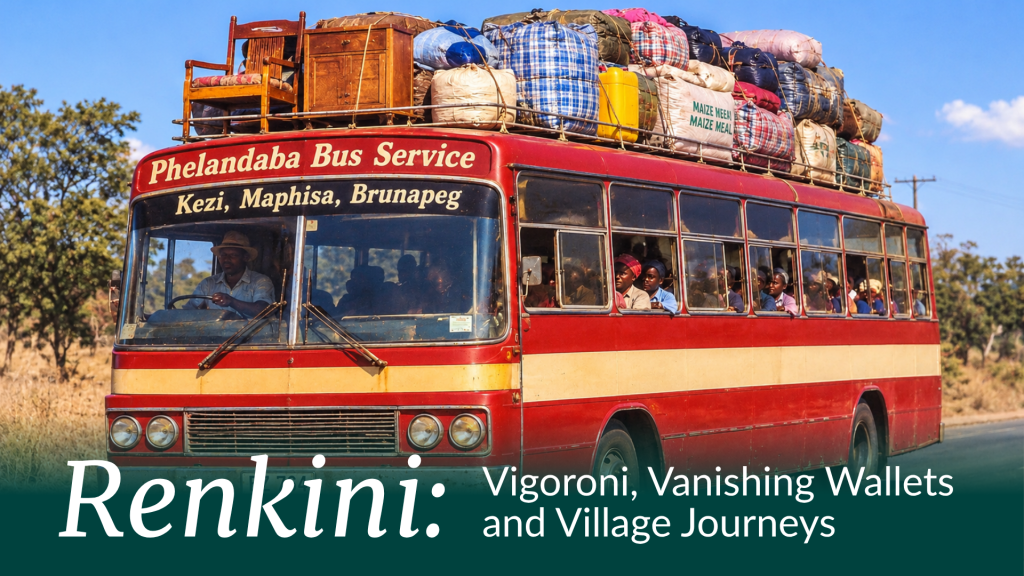
Renkini had a way of turning a gentleman into a rogue and a lady into a ‘ladette’. It was not a place for the faint-hearted. It was not a place where your manners, education or social status counted for much. At Renkini, everybody was equal and equality meant that, at some point, you were going to sweat, push, shove, shout, bargain, fight for a seat and desperately guard your wallet. Renkini was the great departure point for buses travelling to Matebeleland villages. It was a world of its own, part bus station, part marketplace, part theatre and occasionally, part boxing ring.
Anything you could imagine buying was there. The legitimate shops had their goods, while the black market had its own mysterious supply chain. If something existed, someone at Renkini was probably selling it. And because of that, you could find every type of person imaginable. There were businessmen carrying enough luggage to suggest they were relocating permanently to the village. There were mothers with babies, children with bags bigger than themselves, students returning home, grandmothers who seemed to know everybody, young men looking suspiciously relaxed for people travelling with three suitcases and characters whose only obvious qualification appeared to be the ability to survive Renkini.
For my parents, however, there was one rule. Once schools closed, we were going to the village. No discussion. No negotiation. No “Can we go tomorrow?” My parents, with the full support of Gogo X, believed that the moment school closed, our feet should point towards the village. Schools closed at 11:00 a.m. for the holidays. By the time we walked to school that morning, our bags would already be packed and waiting for us. We would collect them and head straight for Renkini. By 1:00 p.m., we would be there. Waiting. And waiting. And waiting. We hated it. At least, we thought we did. But Renkini had a strange way of teaching you things you didn’t realise you were learning.
For me, it was where my virtue of patience was born. A bus advertised to leave at 2:00 p.m. could arrive at 6:00 p.m. without the slightest apology. Nobody seemed particularly surprised. There was no announcement. No compensation. No customer-care representative standing up to explain the delay. You simply waited. The bus would arrive when it arrived. And somehow, we survived. But the moment the bus appeared in the distance, patience disappeared. Suddenly, everybody became an athlete.
The dignified gentlemen who had been sitting peacefully for hours would remove their jackets and roll up their sleeves. The ladies would tie cloths around their waists to protect their beautiful dresses. Why? Because it was time for ‘vigoroni’. Vigoroni was not boarding a bus. Vigoroni was an Olympic event. It was the moment when everyone tried to enter the bus at exactly the same time in order to secure the best seat. There were no queues. There was no “ladies first.” There was no “children first.” There was only survival. People pushed, shoved, squeezed, shouted and sweated. For perhaps twenty minutes, Renkini became a human pressure cooker. You could arrive at Renkini as a respectable gentleman and emerge looking like you had just completed military training. The women who had arrived in delicate dresses suddenly looked like they had been recruited for a wrestling tournament. And then came the second surprise.
A few minutes after the great boarding battle, people would begin checking their pockets. “Where is my wallet?” “Where is my money?” “Where is my ticket?” Silence. Then panic. The thieves at Renkini were professionals. While everyone else was concentrating on getting onto the bus, someone else was concentrating on getting into their pockets. You could fight your way onto the bus and win the seat of your dreams, only to discover that you had lost your ticket. That was Renkini.
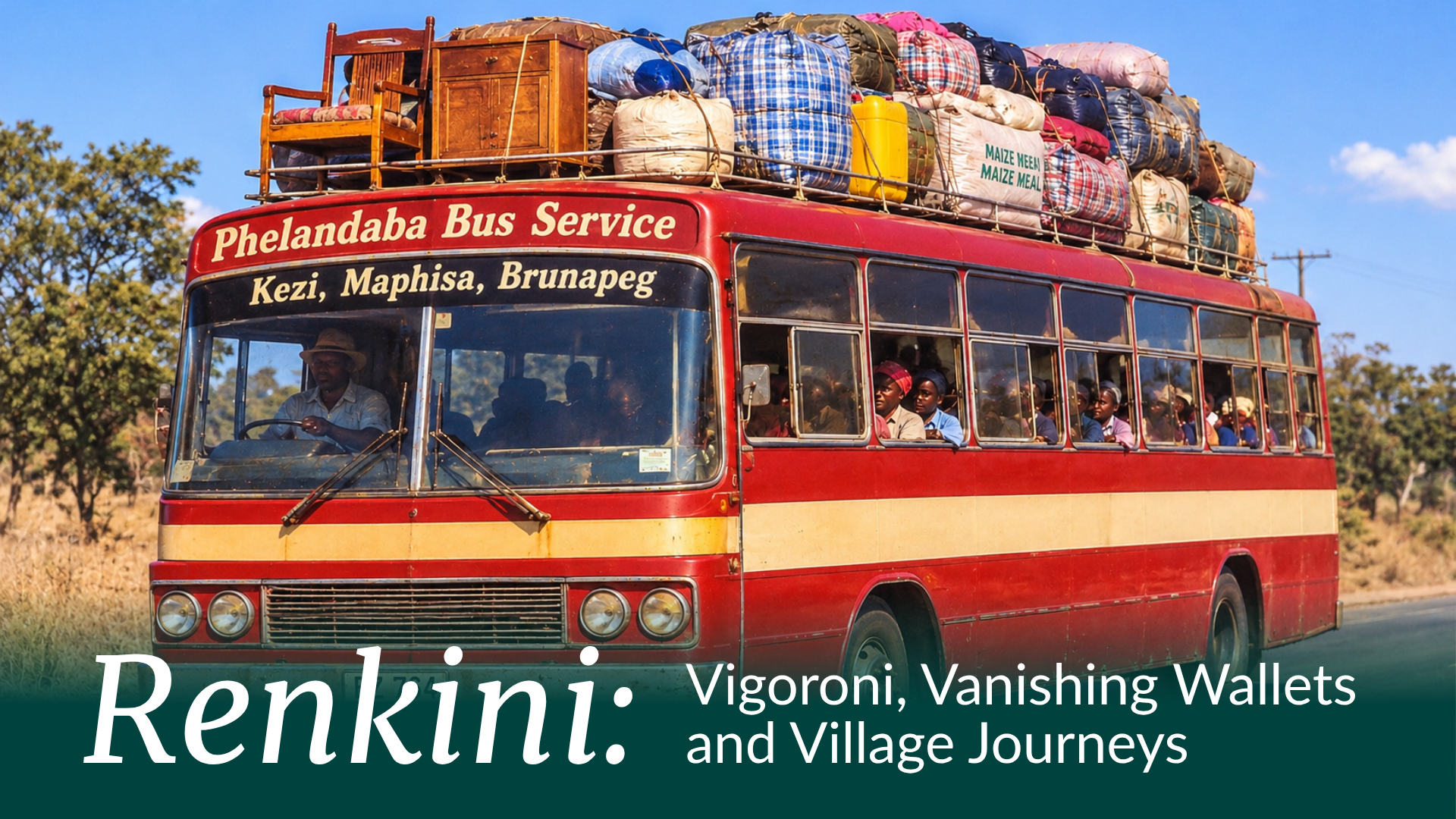
There was always drama. Once everyone was finally inside and reasonably settled, another operation began: loading the bus. And this was where Renkini entered another league altogether. The roof of the bus was not simply a roof. It was additional storage. Beds went on top. Wardrobes went on top. Boxes went on top. Bags went on top. All types of furniture went on top. Anything that was too big to fit inside the bus was considered a candidate for the roof. Sometimes even scotch carts would somehow find their way onto the top of the bus. Looking back, I sometimes wonder whether the bus was actually carrying passengers or whether the passengers were merely passengers accompanying someone’s entire household.
Health and safety? Those words had apparently not yet arrived at Renkini. The philosophy was simple: If it can be tied down, it can travel. If you had not successfully completed the vigoroni, you had better have strong legs. Because you might spend the entire journey standing. Imagine standing from Bulawayo all the way to Kezi? At first there was the noise and movement of the city. Then the buildings became fewer. The roads stretched ahead. The landscape opened up. The bustle of the city slowly disappeared, replaced by wide stretches of countryside, fields, scattered homesteads and that beautiful African horizon that seems to go on forever.
The further we travelled, the quieter everything became. The dust rose behind us as the bus moved along. Trees stood like silent witnesses beside the road. Every now and again, we passed people walking along the roadside, carrying bundles, balancing loads on their heads or simply making their way home. The sun seemed to stretch the journey itself, turning the landscape golden. And somewhere along that road, the irritation of Renkini began to fade. The cramped bus, the sweating, the pushing, the missing wallets, the delays and the furniture on the roof, all of it became part of the story. Because we were going home. At the time, we hated going to the village. We wanted the city. We wanted comfort. We wanted entertainment. We wanted anything that did not involve waiting at Renkini for a bus that had apparently forgotten what time it was supposed to leave.
Yet years later, that village we couldn’t wait to escape became the village we couldn’t wait to return to. Funny how life works. Sometimes the places we complain about when we are young become the places we miss when we grow older. And sometimes the journeys we thought were wasting our time were actually shaping us. Renkini taught me patience. It taught me resilience. It taught me that life does not always operate according to the timetable printed on a ticket. And most importantly, it taught me that when everybody is pushing to get through the same door, you need more than strength. You need patience, wisdom and sometimes, if we are being completely honest,a very good pair of elbows.
FOUR LESSONS FOR THE TRANSFORMERS
1. PATIENCE IS A MUSCLE—TRAIN IT. At Renkini, a bus scheduled for 2:00 p.m. might arrive at 6:00 p.m. There was nothing you could do except wait. Life is sometimes like that. Sometimes you simply have to sit, breathe and wait for the bus to arrive.
2. PREPARATION MATTERS. We knew the moment school closed that we were going to Renkini. Our bags were packed before we even left school. Preparation meant we were ready. The Transformers must understand that opportunities rarely give you enough time to prepare once they arrive. Prepare before the bus comes.
3. SURVIVAL REQUIRES RESILIENCE. Renkini was not comfortable. It was crowded, chaotic, unpredictable and sometimes downright dangerous. Yet we survived it. Life will push you. It will squeeze you. It will make you sweat. It may even steal your metaphorical wallet. But resilience means getting yourself together, checking what you still have and continuing the journey.
4. NEVER DESPISE THE JOURNEY THAT IS SHAPING YOU. As children, we hated going to the village. Today, we look back and realise that those journeys gave us memories, relationships, stories and lessons that money could never buy. Sometimes the very place you are desperate to leave is preparing you for the person you are becoming. So, Transformers, when life takes you through your own Renkini, don’t only ask: “When will this be over? ”Ask: “What is this journey teaching me?” Because one day, you may look back at the chaos, the waiting, the struggle and even the sweat and realise that somewhere between Renkini and the village, you were being transformed.
FOUR POWERFUL LESSONS FOR THE TRANSFORMERS
1. DON’T LET THE CROWD DICTATE YOUR MOVE.
At Renkini, when the bus arrived, everybody rushed, pushed and fought for a seat. But life is not won by joining every stampede. Sometimes the smartest person is not the fastest, but the one who knows when to move and where to position themselves. Stop competing in every race, choose your battles wisely.
2. NEVER WIN A SEAT AND LOSE YOUR WALLET!
At Renkini, people were so busy fighting for the best seats that thieves were busy taking their money. Life can be just as deceptive: you can gain wealth and lose your peace, gain status and lose your integrity, or chase success and lose your family. Don’t become so focused on what you want to gain that you forget what you must protect.
3. WHEN THE BUS ARRIVES, IT IS TOO LATE TO START PACKING!
Our bags were ready before we even left school. We didn’t wait for the bus to appear before preparing for the journey. Transformers, opportunities reward preparation, not panic. Build your skills, sharpen your mind and prepare in private so you can perform when your moment arrives.
4. DON’T CURSE THE JOURNEY THAT IS CREATING YOUR STORY.
We complained about the delays, the crowds, the standing and the long road to the village. Today, those very experiences have become some of our richest memories. What feels like an inconvenience today may become your greatest lesson tomorrow. Don’t just survive the journey; discover what it is building in you.