In our home, the rooster was not an alarm clock, he was competition.
If he dared to crow at four in the morning, my mother was already awake. By the time his sound stretched across the village, she had tied her doek securely around her head, tightened her skirt and begun calling our names with the authority of a general summoning soldiers to the front line.
“Wake up! The soil does not wait for dreamers!”
We would rise from our mats reluctantly, our bodies heavy with sleep and make our way toward the fields while the moon was still lingering in the sky. Other children were wrapped tightly in blankets, deep inside their sweetest dreams. We, however, were marching toward the farm like unpaid interns in a family corporation that did not believe in sick leave.
I hated it.
There is no poetic way to soften that truth. I truly hated it.
By the time other families arrived at the fields stretching and yawning, we were already halfway through our work. As a child it made me question the management, l mean my mother.
I often wondered why my mother insisted on this routine. Why the rush? Why the relentless discipline? Why couldn’t we live like other families who seemed to wake with the sun instead of racing it?
One morning, feeling unusually brave and positioned a safe distance ahead of her, I gathered the courage to ask.
“Why do we wake up so early? What is the rush?”
She stopped walking. Slowly, she turned and looked at me. Her face was calm, unreadable.
“What would you like to do instead?” she asked.
Wisdom was chasing me that morning, but unfortunately, I was faster.
“I want to wake up late,” I said boldly. “And eat as many peanuts as I want. Without anyone telling me anything.” I loved peanuts like crazy.
The silence that followed was not ordinary silence. It was the kind that makes even the wind reconsider its responsibilities. My mother said nothing. And in that moment, I regretted my literacy.
The walk home felt longer than a sermon without a closing prayer.
When we arrived, she disappeared into the kitchen. I assumed my boldness had been dismissed or quietly stored for future reference. Then she called my name.
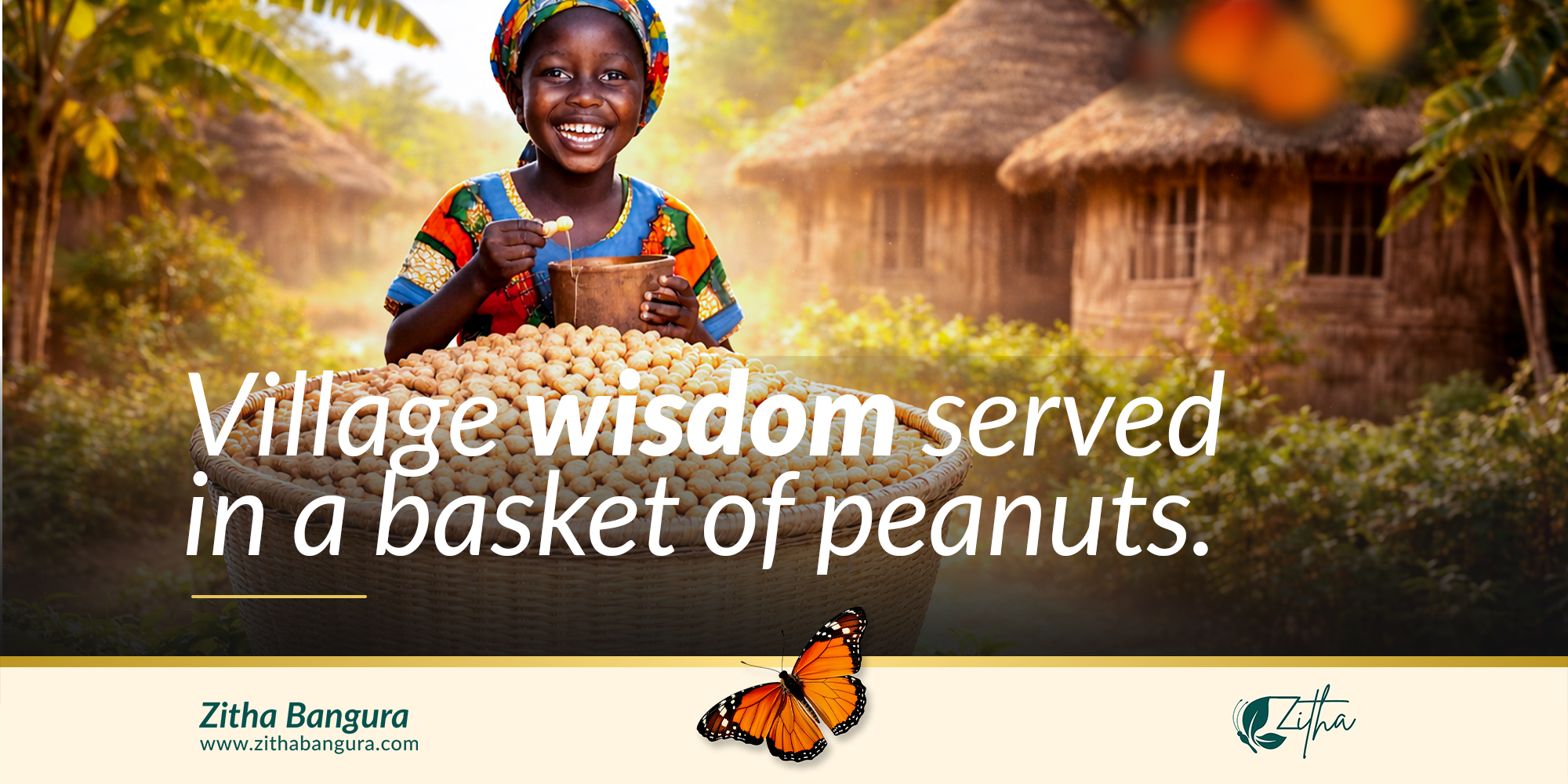
Before her sat the largest isitsha I had ever seen isitsha is an African basket wide and deep enough to carry two toddlers and their stubborn attitudes. It was filled to the brim with peanuts.
“Here are your peanuts,” she said gently. “Eat as much as you want. If you want more, call me.”
Joy flooded my small body. Finally, speaking up had produced results. I sat down like royalty ascending a throne and began to eat.
At first, I ate with speed, the kind of speed that suggests one fears policy might change at any moment. Hand to mouth. Hand to mouth. There were no siblings negotiating shares, no instructions, no limitations. Just me and my freedom.
Soon, however, thirst arrived uninvited. My tongue felt as though it had signed a contract with the Sahara Desert. Right on cue, my mother appeared.
“What do you need?”
“Water,” I croaked.
As I attempted to stand, she lifted her hand gently.
“No. Don’t get up. I will bring it to you.”
My smile stretched across invisible borders. Look at this promotion. I was now dispatching my mother on errands, l was beaming inside.
She returned with a cup so large it deserved its own postcode. I drank deeply. Almost immediately, my stomach sent a message to headquarters: We are at capacity.
Still, pride would not let me surrender. I continued eating, though more slowly now, each peanut negotiating for space.
Eventually, I could not go on.
My mother returned again. “Why have you stopped eating?”
Before I could confess defeat, she spoke firmly. “No talking. Continue eating.”
That was when the tears came. Hot. Honest. Unstoppable.
She looked at me, not with cruelty, but with the steady authority of a woman determined to raise humans, not excuses.
“Greed and laziness will kill you, mntaka ka Isiah… (daughter Isiah,)” she said.
There were no lectures. No diagrams. No community meetings. Village lessons were not delivered through presentations. They were lived. Felt. Remembered.
The stomach ache that followed was so severe it rearranged my personality.
That day, peanuts introduced me to discipline. They taught me that unchecked desire quickly turns into discomfort, that freedom without wisdom is simply self-destruction wearing a smile. They taught me that my mother’s early mornings were not punishment, they were preparation.
As a child, her discipline felt like cruelty. As a woman, I understand it as love in its most responsible form.
I have never underestimated my mother again.
Years later, I would come to see that her lessons extended far beyond farming or peanuts. She was teaching us that comfort is a poor teacher, that character is forged in effort and that leadership sometimes requires allowing experience to speak louder than argument. She did not debate with me that morning. She demonstrated.
And the demonstration stayed with me far longer than any speech could have.
Even now, whenever I am tempted to choose ease over discipline, indulgence over responsibility, I remember the isitsha. I remember the thirst. I remember the tears.
And I wake up early.
4 Takeaways for transformers
1. Discipline Is Not Punishment, It Is Preparation
What feels harsh in one season is often protection for another. The undeveloped mind calls it cruelty; the matured spirit calls it cultivation. Transformers understand that discipline is not designed to break you it is designed to build capacity.
2. Freedom Without Wisdom Becomes Self-Sabotage
Be careful what you demand when you are not ready to manage it. Unchecked desires can quickly become burdens. Transformers do not just pray for opportunity they prepare for responsibility.
3. Comfort Is a Slow Thief of Character
Soft beds and late mornings rarely produce resilient leaders. Growth happens where effort lives. Transformers choose development over indulgence, even when indulgence feels easier.
4. Demonstration Is Greater Than Debate
Not every lesson requires an argument. Some truths must be experienced to be understood. Mature leadership knows when to explain and when to allow life to teach.