In the village, children are raised on two kinds of education, the lessons we were taught, and the ones we learn by watching. One of the first lessons was clear, do not repeat what you hear elders saying. It was never written, never explained. It lived in glances, lowered voices, and the way conversations changed when a child entered the space.
Yet the village also lived on stories. Words travelled faster than feet, moving from yard to yard, cooking fire to cooking fire. And some stories were too rich, too strange, too delicious not to stir a child’s curiosity.
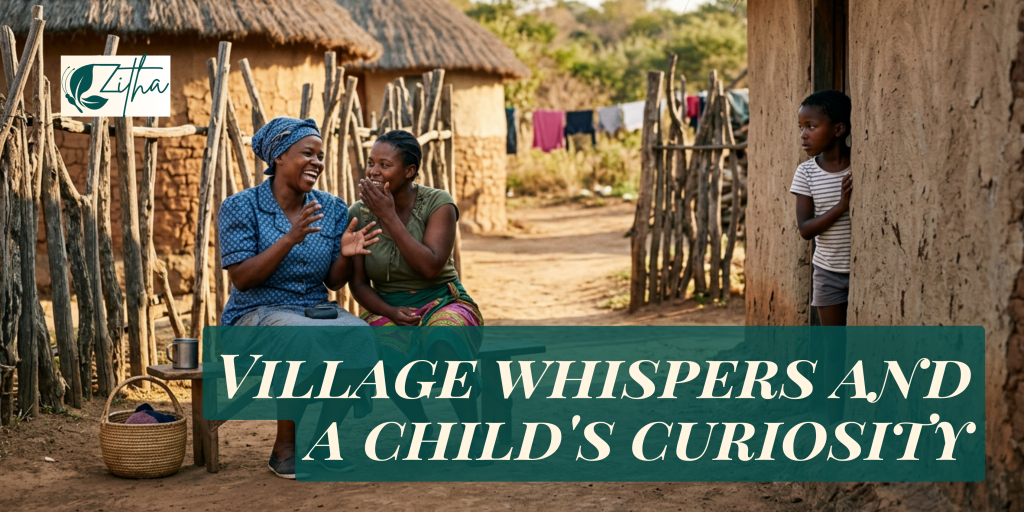
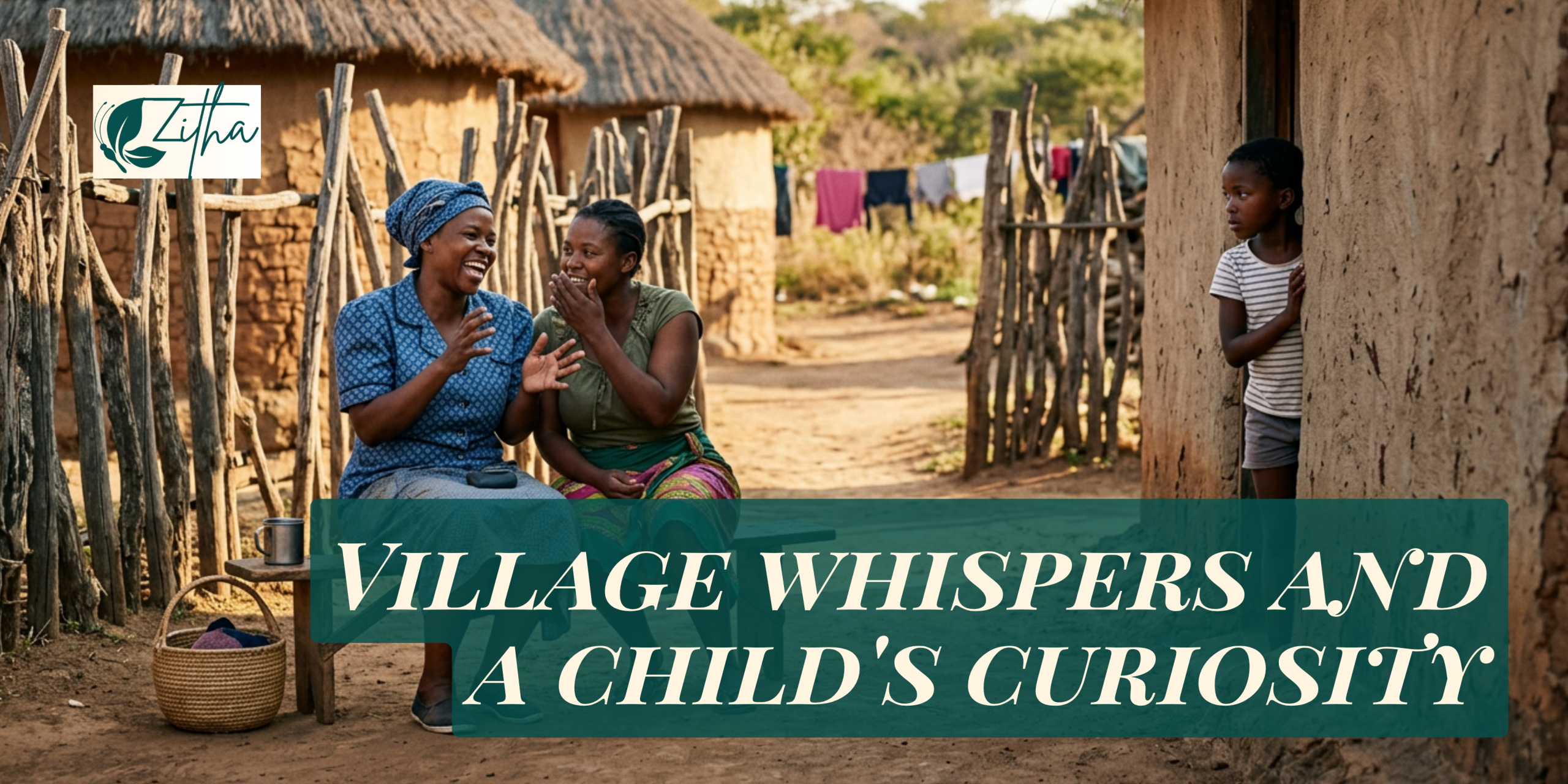
I heard my eldest sister speaking with a friend about one of my favourite teachers, Miss Mlilo. Their voices were low, careful, shaped by secrecy. I did what village children learn early, I burst into song. Singing made me invisible. Once the adults believed I was lost in my own tune, their whispers loosened, and the story breathed more freely.
By the time I arrived at school the next morning, my curiosity was already fully dressed and eager to walk. I shared what I had heard with Bongie. My friend was many things, kind, steady, sensible but she was not a gossip. To say she was uninterested would be an understatement.
I think Bongie understood something I did not yet know, in the village, not every story is yours to carry. Some belong to the elders, some to time and some to silence.
Miss Mlilo had been absent for weeks. No explanation had been given, because in the village, adults believe children do not need reasons, only instructions. I begged Bongie to help me ask one of the teachers, but she refused. “I don’t want trouble,” she said. She knew that questions, in a village, can easily be mistaken for disrespect.
Trouble, however, found me anyway.
As the headmaster walked past, the question leapt out of my mouth before wisdom could catch it. “Excuse me Sir when is Miss Mlilo coming back?”
He stopped and pointed at me.
“Wena.” (You)
Two syllables.
A full sentence.
Mind your own business.
In the village, authority does not explain itself. It corrects. Bongie’s silence scolded me harder than his words and I learned that curiosity spoken aloud carries consequences.
Two weeks later, Miss Mlilo returned.
I studied her face the way villagers study the sky looking for signs. The story I had heard spoke of unseen beings, of spiritual violence, of punishment that leaves marks. The village often explains illness through the language it knows best, the supernatural. But her face told a quieter truth. It was whole. Undamaged.
Still, the story inside me demanded release.
I stared at her face, searching for the damage I had heard about. The village story said she had been beaten by an unseen being, disfigured, and rushed to hospital. But her face told a different story. There were no scars. No signs. Nothing.
I knew I should stay quiet.
But curiosity has a voice of its own.
I asked her if it was true if she had really been beaten by an unseen being.
The air shifted. Her anger was sharp, sudden and heavy with something older than me. When she demanded to know where I had heard such a thing, fear folded me small. I told her everything. Names. Sources. The journey of the story.
She spoke of a “stroke” a word that did not belong to village folklore, a word too clinical for fireside conversations. She spoke of pain turned into gossip, of suffering turned into spectacle. In that moment, I saw how the village can take a person’s private wound and make it communal property.
I was in trouble.
Bongie walked away. In the village, distance is also a language.
At home, I couldn’t even play. Anxiety clung to me as daylight faded. Then, just before dark, Miss Mlilo arrived. She confronted my sister about what I had said. My sister denied gossiping. She said they had been talking out of concern, worried about Miss Mlilo’s health.
And then the village did what villages have always done it corrected the child, not the system.
My sister was in the army, you know what that means right? It means she disciplined me. That day, my childhood curiosity was initiated into silence. I learned that in the village, children are shaped not only by love, but by fear and order.
Miss Mlilo was never my favourite teacher again. Not because she was wrong but because, to a child, justice feels different when adults protect one another.
Years later, I understand.
The village was not cruel.
It was protecting itself the only way it knew how.
4 Deep Transformational Takeaways
1. Silence in Communities Creates Stories
When truth is withheld, imagination fills the gap. Villages, families, and organisations must learn that silence often gives birth to myths that wound deeper than facts ever could.
2. Not Every Story Is Yours to Carry
Wisdom teaches that stories have owners. Carrying a story without permission turns curiosity into burden. Transformation begins with discernment.
3. Pain Is Often Explained Through the Language of Culture
When knowledge is limited, culture fills the gaps. Illness becomes superstition, suffering becomes myth. A transformer learns to translate pain with compassion, not judgment.
4. Correction Without Understanding Creates Quiet Rebels
The village corrected the child but never explained the wound. True transformation does not just discipline it teaches, names pain and restores dignity on all sides.