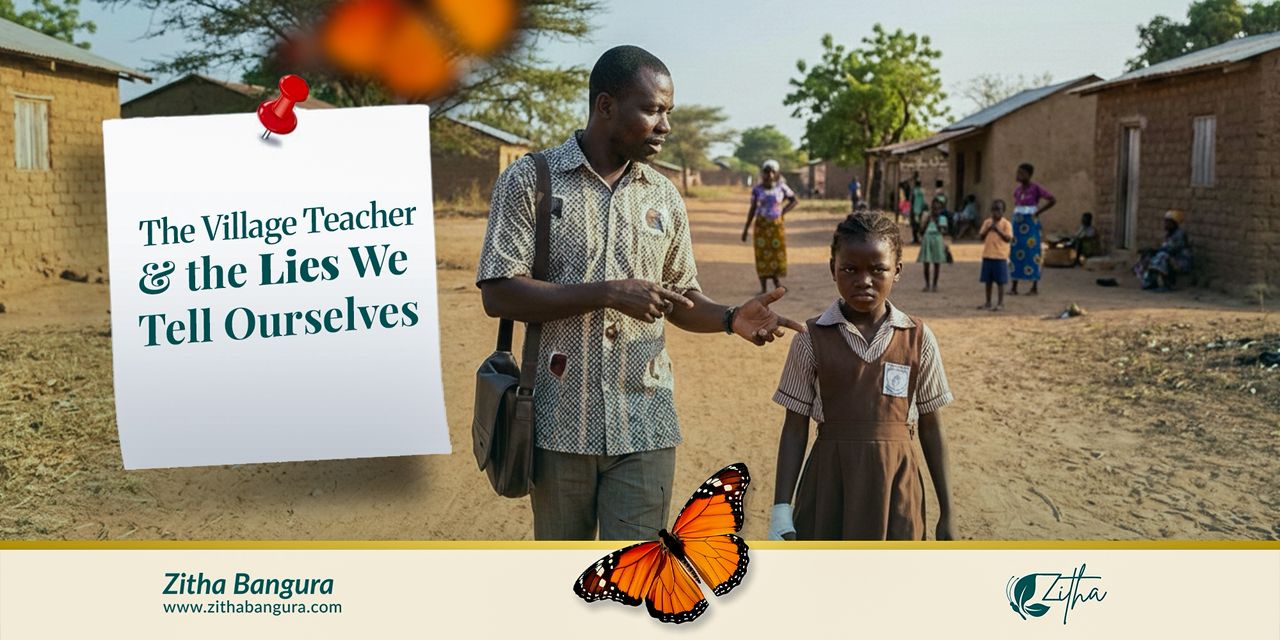
The ten-minute walk from school to my home with Mr. Moyo felt like a forced pilgrimage.
To me it was torture, to him, apparently, it was an opportunity.
Every few steps he fired a mathematics question at me, as if we were in a pop-up exam nobody asked for.
“Seven times eight?”
“What is half of ninety?”
“If you have twelve sweets and…?” “Ayi, ayi” what is wrong with adults, learning should end in class.
I was injured, tired, hungry, and frankly shocked that learning was still happening outside school hours. Didn’t he understand that school was finished?
The bell had rung. My mind had logged out. My brain had already gone home ahead of me.
But clearly, he had sensed something during that walk, something that made him keep going.
And something that shocked him more than my bleeding finger, how much mathematics I didn’t know.
I, on the other hand, was irritated. A sore finger, a long walk, and now equations?
It felt unfair. I even wished he’d talk about anything else the weather, politics, goats or even the village gossip, but he kept choosing numbers like he had a personal grudge against me.
When we arrived my mother was irritated at having my teacher come home before she even knew what it was. My Mother hated unnecessary attention because it kept her away from her work. I knew the look but Mr Moyo didn’t.
Mr Moyo did not waste much time he jumped on the issue about my finger, my mother was shocked that l had hidden it from her. I knew that all my siblings were in trouble for being accomplices in hiding this from her. When Mr Moyo explained that the finger will need to be looked after so that it does not get infected she gave me “the” look. I must admit even though l was injured, l enjoyed the attention.
When Mr Moyo left my mother said “wena ulesibindi ungambulala umuntu” direct translation “you are tough you can kill a person”. I left her and went to Gogo X and Y who also had no sympathy for me.
Still, Mr Moyo never mentioned the maths issue again.
Not that week.
Not the week after.
Instead, he gave me something else, attention and l love it, even my classmates were jealous they had no injured fingers. I loved the bandage ritual.
For the following few weeks, the changing of my bandage became a whole event in my class.
Every three days, Mr. Moyo brought out the first-aid box, and the entire class gathered around like spectators at a live show.
I won’t lie, the attention was awesome.
I felt like the main character in a television series I didn’t even audition for.
There was sympathy, curiosity, and even admiration.
And in the middle of all this, I was also happy Mr. Moyo wasn’t telling the whole world about my terrible maths performance during that dreaded walk home.
My finger was healing, too fast.
My confidence was rising.
And then “ah” he struck.
Not with a stone this time, but with a sentence.
The Bombshell.
One morning, after confirming my finger had fully healed, Mr. Moyo stood in front of the class and made an announcement that cleaned the smile right off my face.
“There are some pupils who need extra lessons in mathematics,” he said.
“If I call your name, stay behind after school.”
He called the first two names.
I relaxed.
By the third name, I was practically celebrating internally.
Then he called mine.
My stomach dropped so hard I’m sure the whole classroom heard it.
Me?
Extra lessons?
But I was in Group One, the top group!
The chosen ones!
The smart ones!
Except… I hadn’t earned that spot honestly.
My friend Bongie was a maths genius, and I borrowed her answers whenever possible.
Quietly. Consistently. Confidently.
And now here I was paying the price for academic fraud and injured fingers at the same time.
I rushed to Mr. Moyo and whispered that my mother was waiting for me after school.
He didn’t even blink.
“I already spoke to her about this when l took you home,” he said calmly,
“When I realised how much support you need.”
Support.
The polite word for you’re struggling.
Then he made things worse by adding,
“I don’t understand how someone so good in English can be so… limited in mathematics.”
“Daaah”.
Did he expect me to answer that?
Even I didn’t understand it.
The lessons nobody asked for were every day except Friday.
For a child, that was a life sentence.
They stole our playtime, drained our energy, and created resentment so deep that if Mr. Moyo had no enemies before, he certainly gained a few now.
But what he didn’t know was this, I had already decided maths wasn’t mine.
Not because of him, but because of my mother’s words, repeated often enough to become truth in my mind.
She would say,
“I was good in English, but maths was always difficult.”
And without realising it, I wore that as a badge of identity.
If she struggled, why should I be any different?
Why should I try harder?
Why should I expect more from myself?
I didn’t know then what I know now that repeated messages especially from people we love and look up to become shortcuts in the brain.
They become beliefs.
And beliefs become limits.
So, of course I struggled.
I had already decided maths was not my portion.
Extra lessons didn’t help much.
Our minds were never there.
After school, every child’s spirit flies ahead of their body, and no teacher can force it back.
Years later, when I needed maths to enter university, I had no choice but to start again.
But this time, I approached it differently.
I tried.
I engaged.
I understood formulas rather than fearing them.
And I passed.
Not because I suddenly became a genius but because I rewrote the story, I had been telling myself since childhood.
4 Takeaways for Transformers
1. A single repeated message can shape or limit a child’s entire identity.
The words spoken around us become the beliefs inside us.
Be careful what you absorb and even more careful what you pass on.
2. Borrowed answers create borrowed confidence.
Real confidence is built on real effort.
Shortcuts feel good in the moment but collapse when tested.
3. Healing often exposes deeper wounds.
My finger healed faster than the belief that I “wasn’t good at maths.”
Physical injuries are simple, mental ones take intention and time.
4. You can rewrite the story at any age.
Childhood beliefs don’t have to become adult limitations.
Growth starts when you challenge the narratives handed to you.