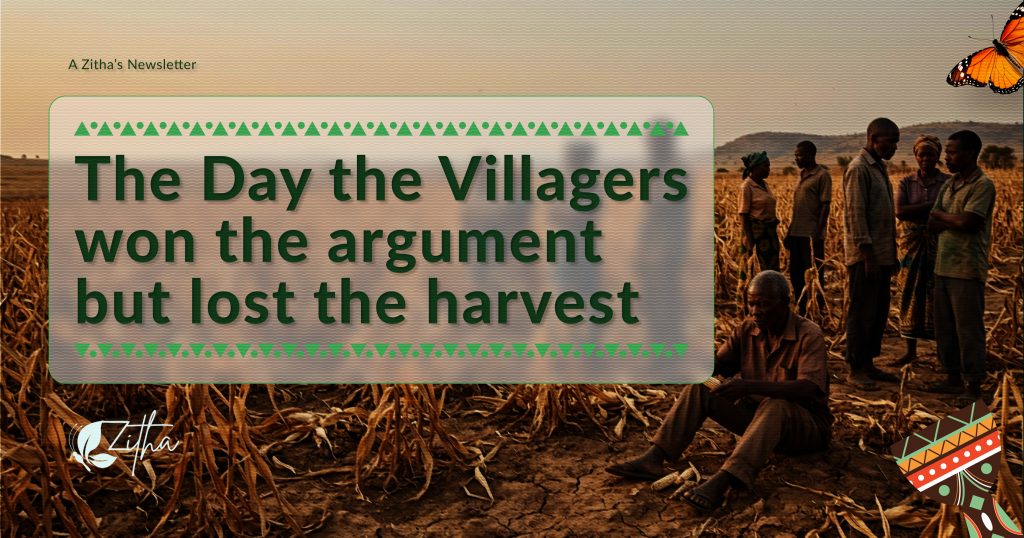

Just when I thought my luck had exhausted itself, it decided to dig a deeper hole. You see, before she left for the burial, my mother had sealed the grain barn with mud a village lock, strong enough to keep out thieves, but not cunning ones. My mother was consoling herself saying at least we will eat last year’s harvest and l had to help by climbing into the barn and pushing the grains closer to the entrance.
When we went to the barn, the barn stood open, the mud cracked, and the inside… empty. Not a single grain left. I could not even close my mouth with shock, we both said “mayiiiiiii” which is an expression for when you are shocked beyond words.
Someone had been helping themselves while I slept.
My mother turned to me, her face unreadable, and asked, who has been stealing the grains? But l didn’t know. Then she said “Did you see any footprints in the morning?”
My heart sank because I had not seen anything at all, what l could not admit to her was that l had heard the dogs barking at night but never investigated in the morning. I regretted it, because in the village, footprints are testimonies. The sand remembers everything. You could track a thief, a goat, or even a gossip by the pattern of their toes.
But I had seen nothing. I’d been too busy reading my book my head filled with Danielle Steel’s characters, not footprints in the sand.
That answer made her furious. Not the shouting kind, the kind that makes your stomach turn cold. She said one person could not do all the foolish things l had done because it was too much. I even knew that l had done too much but it was not deliberate, but you could never say things like that to my mum. She said “uJesu wabulawa ngokungananzeleli kwabantu” direct translation “Jesus was killed because of carelessness of people”. In my head l was thinking aah he died because Judas sold him out.
The thief must have missed the memo that my mother was back and came one last time. This time, my mother caught the trail. She called witnesses, and the whole village gathered like it was a festival. They followed the footprints until they led to the thief’s home.
When he was brought before the village court, justice arrived the old-fashioned way. He had to pay back with two goats. Which was a lot in those days.
The story of my mother’s empty barn and my world-class silliness spread through the village faster than gossip at the water well. Everyone knew that I had somehow managed to turn a season of promise into a season of nothing not even a handful of maize left. My mother’s face said it all, she wore that quiet kind of disappointment that could cook your conscience without fire. I thought the earth might open and swallow me before the rumour did. Two weeks later, while we were in the kitchen pretending to be fine, we heard singing. At first, I thought my mind was playing tricks on me. But the voices grew louder, fuller, and nearer. When we stepped outside, there they were our entire village, men and women, dancing towards us like a walking harvest festival, baskets upon baskets of grains on their heads, smiles wider than the river.
I just stood there, uselessly holding a spoon, trying not to cry and trying not to laugh because honestly, how had I caused a disaster big enough to make the whole village organise a rescue mission. The kindness was so overwhelming that even my mother began to sway to their song, with tears streming down her face. They poured out their gifts millet, maize, groundnuts, joy and our kitchen transformed into a banquet of grace. We sang, we danced, and we ate until our bellies forgave our hearts. That day, I realised the village didn’t just rescue us from hunger they rescued me from the weight of my own foolishness. It was funny, humbling, and holy all at once. This was proof that in my village, even mistakes could be turned into music.
In the end, the grains were gone, but the lesson stayed. That year, I learned that in the village, freedom always has a price and that silence, disappointment, and a missing harvest could teach you more than any beating ever could.
Because sometimes, the fire that raises you isn’t in the stick or the scolding it’s in the quiet realisation that you could have done better.
And believe me, that realisation burns longer than any firewood.
The lesson that year was loud and clear: choosing freedom without responsibility is just another form of foolishness.
Four takeways for Transformers
1. Pay Attention
What you ignore today can cost you tomorrow.
2. Own Your Mistakes
Accountability grows you faster than excuses ever will.
3. Value Your Community
Your relationships are your safety net and your wealth.
4. Let Failure Teach You
Mistakes aren’t the end they’re the beginning of wisdom.