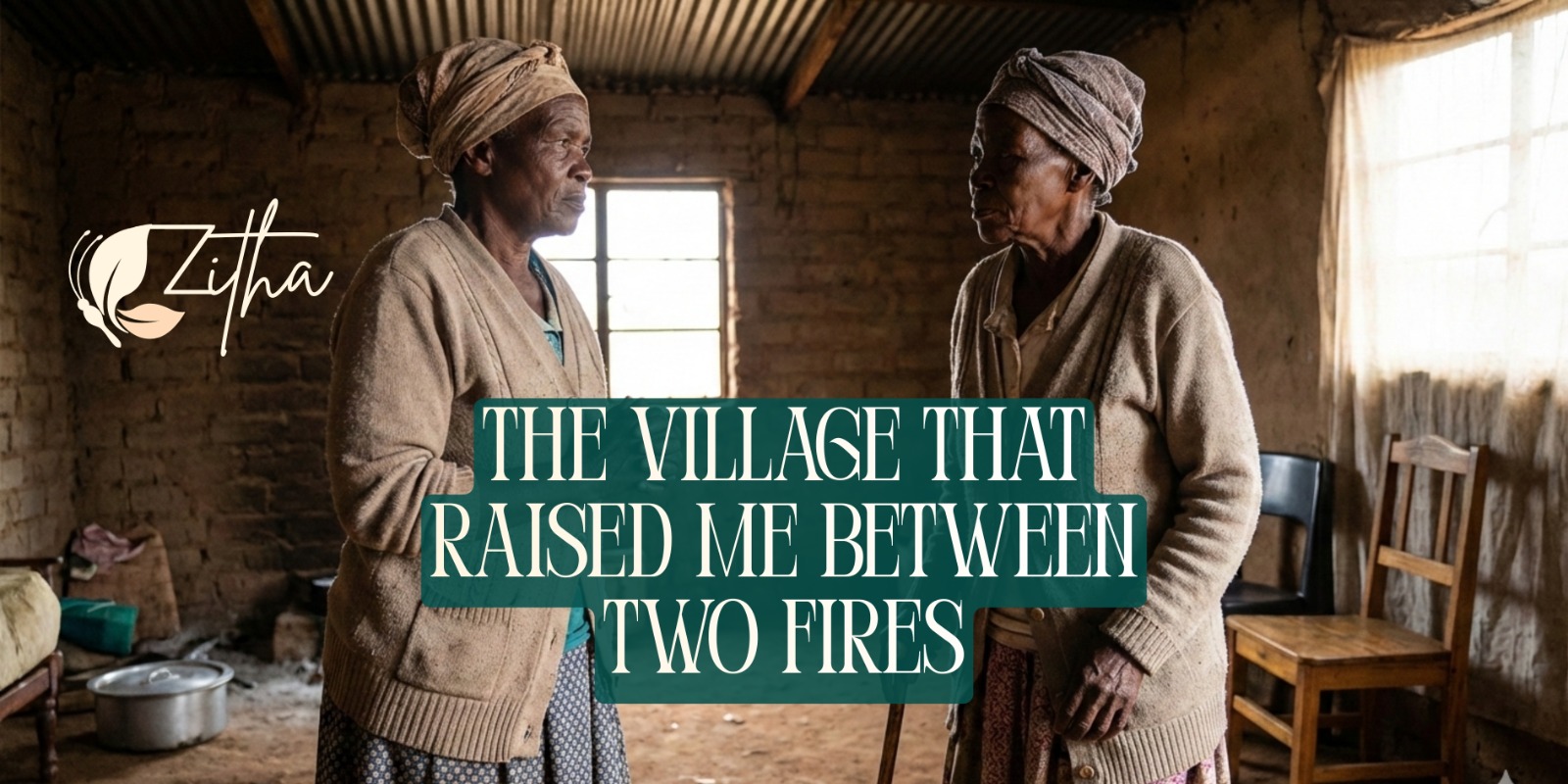
I grew up with two grandmothers. To avoid confusion and to preserve family peace, I will call them Gogo X and Gogo Y.
Both my parents are last-born children, and in our culture, the last-born inherit land, traditions, unspoken expectations, and they inherit their parents, too. That is how we came to live with both grandmothers at once, two women, one homestead, and a lifelong competition disguised as civility.
Gogo X was the authority on children. She had raised fifteen grandchildren and carried that fact like a certificate pinned to her chest. In her world, children were very simple beings; they were meant to eat, then sleep. If they did not sleep, it meant only one thing, they were still hungry. Misbehaviour was not developmental in her eyes, it was intentional.
On the fateful day, my mother had gone to a funeral. We loved it when she was not home because when we were growing up funerals took the whole day. When Mum was home, order prevailed. When she left, freedom stretched its legs. The grandmothers rarely left the kitchen, and the rest of the world felt suddenly available to us.
Gogo X fed us generously, and we ran off to play. We did not sleep.
This troubled her.
“If they haven’t slept,” she decided, “they need more food.”
She served us again “isitshwala” (thick porridge) with “mthariyo”, a traditional fermented soup, usually left in the sun to develop its taste. We all hated it. Gogo X placed it outside for a little longer to ferment it more, confident in her experience and unaware that it had crossed a delicate line.
We ate quickly. Play was waiting.
I noticed my brother nodding off and laughed. Then something heavier than laughter settled over me. A tiredness unlike any I had known took hold, deep, consuming, irresistible. Years later, I would recognise it as the kind of exhaustion that empties you after childbirth, when the body simply decides it has done enough.
I do not remember falling asleep. I remember drifting.
Somewhere between waking and dreaming, I could hear chickens pecking at leftovers. The sound felt distant, as though it belonged to another world.
My mother’s voice pulled us back.
We were asleep under the open sun. The shade had moved on without us.
We woke easily enough, but our bodies refused to cooperate. We tried to stand. We fell. Tried again. Fell harder.
At first, Mum thought we were playing.
Then her irritation softened into something else, fear.
She called the grandmothers. They told us to stop being silly and stand up.
We tried.
We failed.
Now we were frightened too.
“What did they eat?” Mum asked.
“Mthariyo,” Gogo X replied.
Mum lifted her hands to her head a gesture that needs no translation. It meant disaster.
She thought we had been poisoned.
Gogo X unravelled in real time. Gogo Y, however, found clarity in the chaos.
“So,” she said calmly, “you think you know everything. Now you have poisoned the children.”
When we heard the word poison, we responded as children do. We clutched our stomachs. We groaned. We performed pain we did not feel.
Fresh milk was needed to induce vomiting, but it was late. The goats had long gone to the bush. Panic filled the air.
My mother cycled to fetch the village health worker who came at once hearing the word poison.
She smelled the “mthariyo” and laughed.
“This isn’t poison,” she said. “It’s alcohol.”
The children, she explained, are not dying, they are intoxicated.
Relief did not repair the damage. The tension between Gogo X and Gogo Y had already rooted itself deeply.
We were told to drink water. The more we drank, the heavier our limbs became. That night, we slept early, a deep and untroubled sleep.
Sometime before morning, consequence arrived unannounced and with a vengeance. Our stomachs cramped and twisted and this time the pain was undeniably real. Whatever had been quietly fermenting inside us had reached its breaking point, our bodies could no longer negotiate. We ran to the bush with urgency, dignity abandoned along the way, diarrhoea did not ask for permission. Our sprint was powered by a survival instinct that required no strategy, only movement. There was no mercy from Gogo X. She watched the chaos unfold with the calm authority of someone who had witnessed this lesson many times before and simply declared that it was good for us and that it was cleaning our stomachs. And just like that, our suffering was reframed as medicine.
Gogo X, restored to authority even in guilt, declared that we had wished it upon ourselves by pretending we were poisoned. Gogo Y said Mum should not leave us anymore because if we don’t sleep during the day Gogo X might feed us “mthariyo” again.
We knew that what Gogo Y was saying would not be considered, Mum would not take us anywhere.
I sometimes think about that day, the innocence, the misunderstanding, the way fear spreads faster than truth. About how easily wisdom can ferment into danger when left unchecked, and how even love can harm when certainty refuses to listen.
Whenever “mthariyo” was mentioned, Gogo Y would smile just a little too knowingly.
Four take aways for transformers
Experience Is Valuable, But It Is Not Infallible
Gogo X had raised many children, and her confidence came from experience. Yet experience, when left unexamined, can become dangerous certainty. For transformers, this is a reminder that what worked before may not work now. Wisdom is not proven by how much we know, but by how willing we are to keep learning.
2. Unchecked Assumptions Can Cause Real Harm
The belief that children must sleep after eating led to a chain of decisions that no one questioned until fear took over. Transformation begins when we learn to pause, observe, and ask better questions. Assumptions, even cultural ones, should be examined with compassion and courage, because what goes unchallenged can quietly injure.
3. Fear Distorts Reality, But Truth Restores Balance
The moment the word poison entered the story, panic took control. Fear turned confusion into catastrophe. Yet truth simple, calm, factual brought clarity. Transformers learn to regulate emotion before reacting, to seek truth before assigning blame, and to allow understanding to settle what fear inflames.
4. Every Childhood Moment Plants a Seed
This story may be humorous, but it reveals something deeper, children absorb how authority, conflict, blame and care are modelled. Transformers understand that healing is never just personal it’s generational. We revisit our stories not to relive them, but to transform what they planted.